
I went to see The Odyssey with my son Finn on my birthday this year. He’s 25 now, but Odysseus has been knocking around in his life for a long time. When he was little, he used to watch an animated version of the story over and over again — although the Cyclops terrified him. He loved it and was scared stiff by it, which is probably not a bad introduction to Greek mythology.
So when Christopher Nolan announced that he was making The Odyssey, Finn was always going to be interested. Last Christmas, in anticipation of the film, he bought me a beautiful hardback copy of Homer’s poem. I already owned one — a battered old Penguin Classics paperback that had belonged to my late dad. His dates back to his student days and looks like it. The cover is worn, the spine has seen better days and the price printed on the front is 3/6.
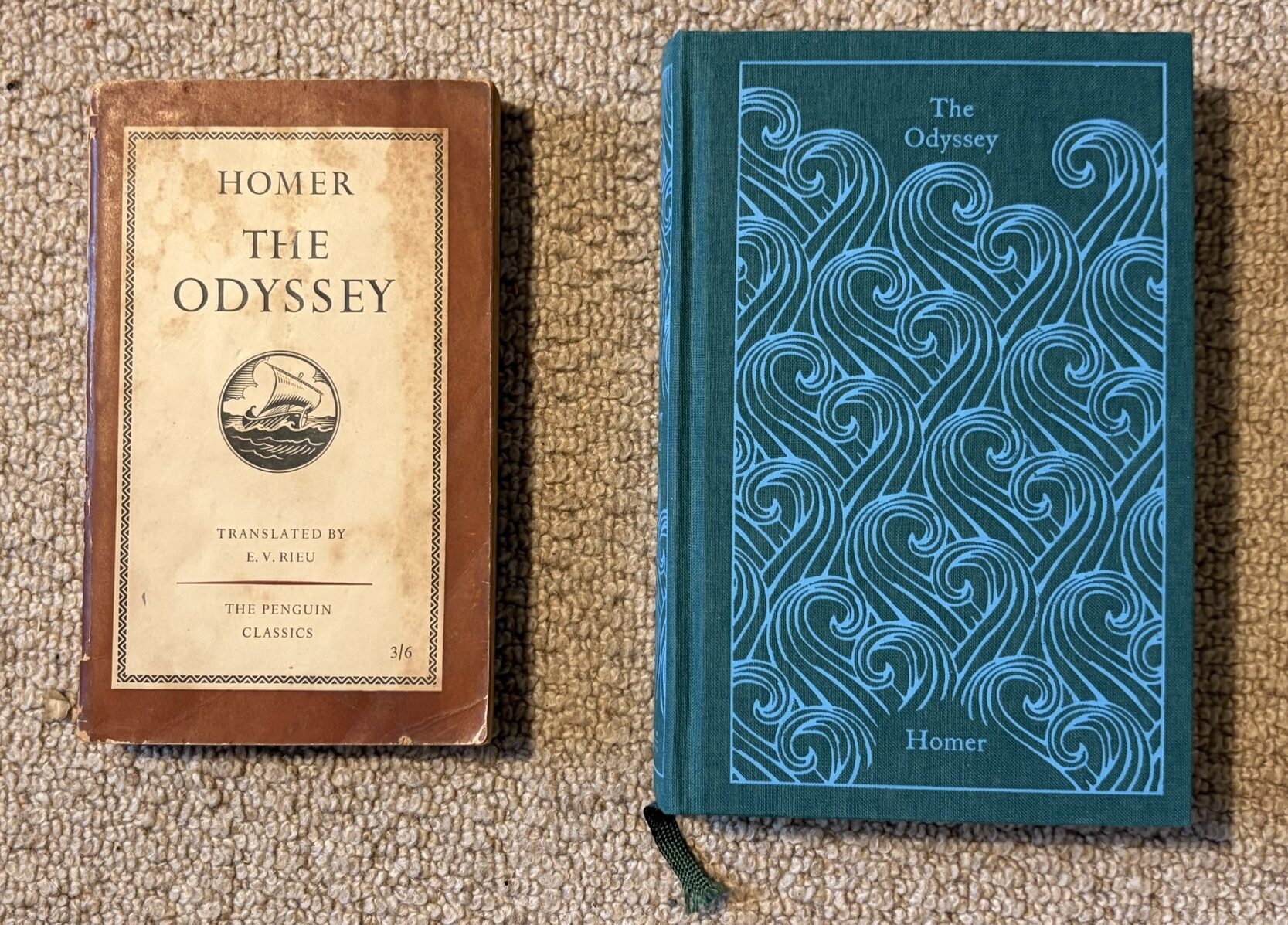
I put the new one alongside it and noticed something I hadn’t expected. Finn had bought me the same translation, even though there are options.
Both are E. V. Rieu’s translation — first published by Penguin in 1946. Finn had no idea. He hadn’t checked the old book or deliberately sought out the same version; he’d chosen an edition he thought I’d like. So I now have two copies of the same words, bought many decades apart — one by my dad when he was a young man, and the other by my son, long after my dad had died.
I’m wary of attaching too much meaning to coincidences, but I like this one.
There is something appropriate about it being The Odyssey, too. This is a story that has already made a ridiculous journey. People were telling versions of it centuries before anyone wrote down the text we now associate with Homer, and it has survived for something approaching 3,000 years by being told, translated, adapted, and told again.
Finn first encountered it as a cartoon. My dad read Rieu’s translation. I have his book, and now another copy of the same translation from Finn. And this summer the two of us sat in a cinema together and watched Nolan tell the story again. He told it well.
That is one of the things I love about old stories. We sometimes treat the classics as things that have been preserved — important cultural objects carefully carried down through history. But stories don’t survive like that. They survive because people keep finding them, enjoying them, and passing them on. They change form along the way. A poem becomes a book, then a cartoon, then a film. A terrifying one-eyed giant remains a terrifying one-eyed giant.
And somewhere in all that, a book passes from a father to a son, and somehow another copy of the same book returns in another form from a son to a father.
It took Odysseus ten years to get home. This copy of his story took a little longer to find its way to where it needed to be.